baxi-news-banner

Helping your customer decide if an air source heat pump is right for them

When speaking to customers looking at getting an air source heat pump installed at their property, you’ll likely have to answer some in-depth questions.


And we realise it can be hard to know if you’re giving them the right advice. Read on to learn how you can help your customer decide if an air source heat pump is right for them and their home.
Baxi_Harvard_1280x853

How heat pumps actually work


This is probably going to be the first question you’re asked by a homeowner. The easiest way to explain how a heat pump works is to think of it as being like a fridge working in reverse. 


The unit draws heat from the air outside, where it is captured by a liquid refrigerant. As the refrigerant’s temperature rises, it releases a gas, which is compressed to raise its temperature further and the heat is then transferred to the property’s heating system. This is essentially the same process that allows a fridge to stay cool even during hot weather.

Is the property suitable for an air source heat pump in the first place?

Air source heat pumps can be fitted at most property types. Changes to certain regulations have also made it easier to have an ASHP installed under permitted development rules. There are, however, some important considerations that installers and homeowners should both be aware of: 

Sound levels


As of May 2025, the noise from an air source heat pump cannot exceed 37 decibels (dBA) when measured from the closest habitable room of your neighbour’s property . This is in accordance with the MCS 020 sound limit.

 
The level of sound that is recorded depends on several individual factors. Sound can ‘bounce’ off walls and appear to be greater when the unit is positioned in a certain way. At Baxi, our heat pumps are designed to be very quiet and placed at almost any location on the property, making air source heat pumps an accessible option for most homes.

Is there enough outdoor space?


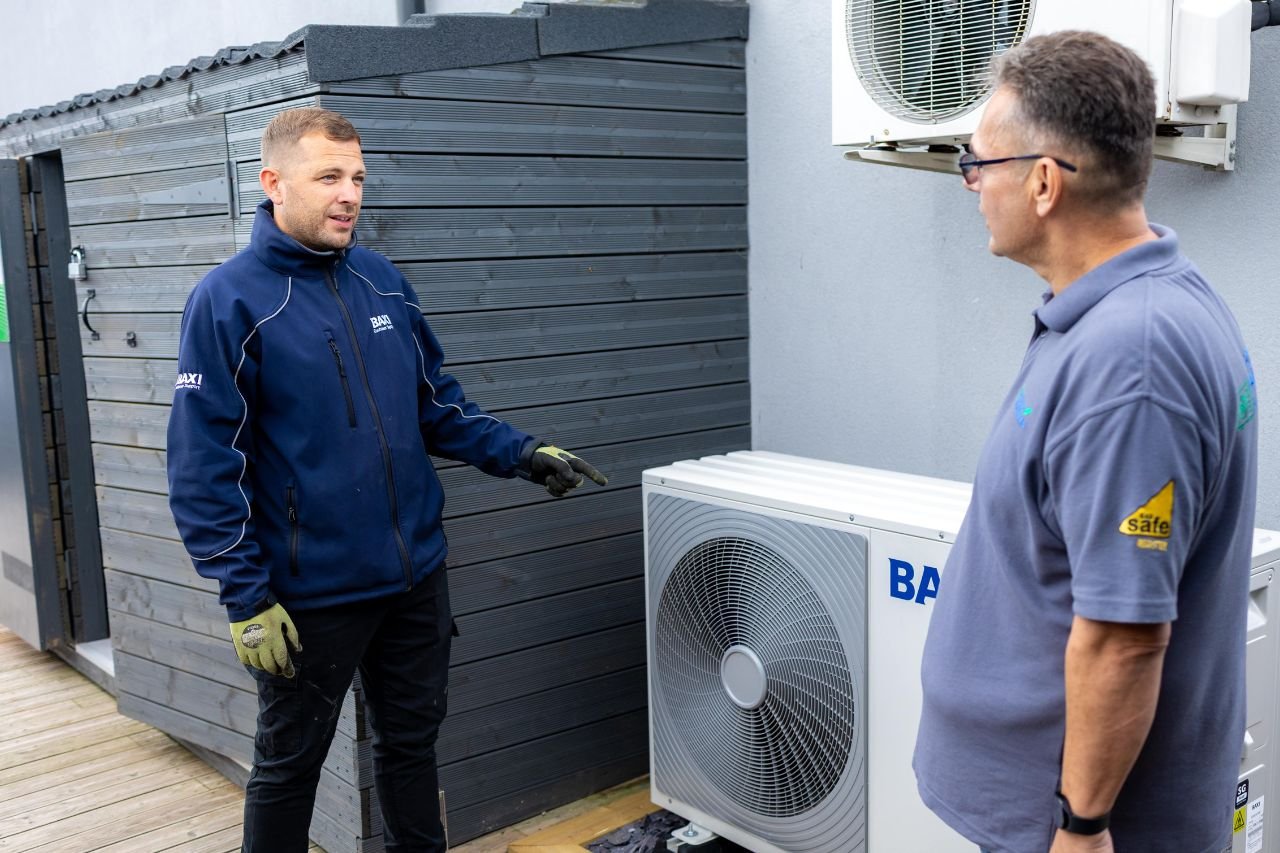
The air source heat pump will need to have enough outdoor space to draw in enough ambient air to operate effectively. Updated regulations in 2025 have removed the need for the heat pump to be at least one metre from the property boundary, as had previously been the case, meaning that in essence, it is possible for a heat pump to be positioned anywhere within the perimeter of the garden.


That said, it’s important that there are no obstructions in front of the heat pump, including anything being propped against it, like bicycles or garden furniture. Noise, again, will also need to be a consideration. It’s important that the installation recommendations from the installation manual are followed closely.

A stable surface


The heat pump will need to be situated on a flat, stable surface, ideally at the back or at the side of the property. This allows for suitable air flow, with the surface itself being able to support the eight of the unit without transmitting noise or vibration into the house. 


It’s also advisable to have gravel underneath the heat pump for condensate to safely dissipate into to reduce the risk of a slippery floor.

Can a heat pump work with existing radiators or heating systems?


As air source heat pumps work at lower temperatures than boilers, there may be a requirement for radiators to be modified, though this isn’t always the case. Underfloor heating systems, however, work well with heat pumps. 


A heat loss calculation is key in working out whether radiators need to be upsized. In most cases, one or two radiators might need to be changed.

Maintaining heat pump efficiency in cold weather


It’s not uncommon for homeowners to have concerns about whether an air source heat pump will work in colder weather. The good news is that heat pumps, like our monobloc units, are designed to work effectively even when the temperature drops below freezing. Our HP60 heat pump can deliver 75°C temperature even when the outside temperature is as low as -10°C. 

    
A defrost cycle is activated by sensors within the unit. This essentially puts the heat pump into reverse, warming the outside unit sufficiently enough to melt away frost or ice that may have built up. The process usually only takes a few minutes, with minimal disruption. 


To help keep the heat pump working effectively, it’s important that any debris is cleared from in front of the unit. During the defrost cycle, it’s normal for white steam to be visible – this is completely normal and is a natural part of the process. In fact, seeing steam shows that the heat pump is doing exactly what it needs to.

Is a heat pump energy efficient?


Air source heat pumps don’t use fossil fuels, making them a highly efficient alternative to traditional boilers. According to the Energy Saving Trust, for every unit of electricity it uses, a heat pump can provide three to five times as much heat. 


This efficiency may also lead to cost savings by lowering energy bills and providing a constant, comfortable temperature, rather than having to turn the heating on and off.

Choosing Baxi for air source heat pump installations

 
At Baxi, we’re committed to making air source heat pump installations smooth and straightforward, giving you all the information you need to help your customer make the right choice for their needs. To learn more about installing air source heat pumps in your area, enrol on one of our training courses.

Baxi Training

Discover our comprehensive range of courses and videos designed to enhance your skills and knowledge.

Related Articles